
Table of Contents
- about AIN Journal
- Publishing schedule
- Publication Access and Availability
- EDITORIAL BOARD
- GUIDE FOR AUTHORS
- BEFORE YOU BEGIN
- Declaration of competing interest
- PREPARATION
- Essential title page information
- Abstract
- Keywords
- Abbreviations
- Math formulae
- Footnotes
- Font
- Tables and figure
- Research data
- Research Elements
- Documenting sources
- AFTER ACCEPTANCE
- Fees and Charges
about AIN Journal
The AIN Journal is a scientific and technological development journal that is related directly to Navigation, such as Astronomy, Charts, Oceanography, Electronics and communications. The journal also covers other fields of maritime industry subject areas as maritime safety, maritime energy, maritime administration, management and operations, and marine environment protection. The journal is also interested in covering the fields of maritime shipping, shipbuilding, Maritime Engines, offshore, coastal/inland, government, Safety, security, equipment, training, Maritime law regulations. In addition to all human related activities whether in sea, air, space or land that affects marine industry and encouraging researchers to write in related activities. As scientific Journal Not Including Advertise As Well As no Marketing Activities whether Direct or indirect.
Owned by Arab Institute of Navigation, non-government organization located in Alexandria, Egypt.
P-ISSN: 2090-8202
E-ISSN: 2974-4768
Publishing schedule
AIN Journal Published on Fixed schedules twice a year, In January and July Every Year.
Publication Access and Availability
AIN Journal Available for Free via AIN Website https://www.ainegypt.org/ain-journal/
EDITORIAL BOARD
Editor-in-Chief
Dr.capt. Hesham Helal, President of Arab Institute of Navigation, Dean of Maritime Postgraduate Studies Institute, Arab Academy for Science, Technology and Maritime Transport, secretary General of IAIN.
Members
Prof. Adel Tawfeek, Prof of Marine Engineering – Port Saied University.
Prof. Ahmed El Rabbany, Doctor of Philosophy (Ph.D.), Geomatics Engineering, Professor at Toronto Metropolitan University Toronto, Ontario, Canada, Graduate Program Director, Ryerson University, Canada.
Captain. Atef Sherif, Vice President of the Arab Institute of Navigation, Director Logistics, ORASCOM CONSTRUCTION INDUSTRIES.
Capt. Emad khafagy, Dean, IMO Compound – AASTM, Prof of Navigation.
Assoc.Prof. George Gabedava, Associate Professor and the II Deputy Rector in direction of Education Process Management and International Relations Service at the Batumi Navigation Teaching University Deputy Rector, visiting lecturer at the Shanghai Maritime University.
Prof. Irina Makashina, Professor of the English Department, Head of the Distance Professional Retraining Center, Admiral Ushakov Maritime State University, Novorossiysk, Russia.
Dr. Khaled Mohamed Salem Atta, Arab Institute of Navigation board Member, head of Marketing Unit, post graduate maritime studies, free-lance Consultant.
Prof. Krzysztof Czaplewski, Dsc (Eng) President of Polish Navigation Forum, President of IAIN and Director of the Maritime Institute, Poland.
Capt. L. G. Evidente, Alternate Contact Person for IAMU Matters.
Dr.Prof. M. Abdel El Salam Dawood, Consulltant of Presidnt for Maritime Affairs AAASTMT, Prof. of stability in AASTMT.
Madadh MacLaine, Secretary General Zero Emissions Ship Technology Association, Founding member and member of the executive committee of International WindShips Association; market transformations work stream leader, responsible for organization of events and promotional materials.
Prof. Marina Chesnokova, PhD, Head of International Cooperation Department, Head of Training Centre “Marine Lingua”, Senior Lecturer of English Language Department, National University “Odessa Maritime Academy”.
Captain. Mohamed Abd Elmonem Salem, Treasurer of the Arab Institute of Navigation, Full professor at the College of Maritime Transport at the Arab Academy for Science, Technology and Maritime traspct.
Prof. Mohamed El Gohary, President of Borg Al Arab Technological University.
Capt. Mohamed Youssef Taha, Member of the Arab Institute of Navigation, Consultant of AASTMT Maritime Sector, professor of Marine Education.
Assoc.Prof.Dr. Pelin Bolat, Deputy Dean (Research & Development)/İTÜ Maritime Faculty, Head of Maritime Studies Programme / İTÜ Graduate School, Head of Lab., Maritime Security and Cyber Threats Research Laboratuary.
prof. dr. sc. Pero Vidan, Dekan / Dean POMORSKI FAKULTET University of Split (Sveučilište u Splitu)
FACULTY OF MARITIME STUDIES.
Prof. Dr. Peter Trenkner, Professor (Rtd) of Maritime Communication at Wismar University, Germany, Honorary Member of the International Maritime Lecturers’ Association (IMLA).
Dr.Prof. Refaat rashad, Member of the Arab Institute of Navigation, Senior Lecture of Navigation in AASTMT, Former professor and Expert GNSS.
Dr.Prof. Sameh Kabary Rashed, Secretary General of Arab Institute of Navigation,Vice Dean of Maritime Postgraduate Studies Institute, Arab Academy for Science, Technology and Maritime Transport, Registered as Marine Expert & Consultant “Egyptian Courts”.
Capt.prof. Samy Abo Samra, Arab Institute of Navigation board Member, Former Dean of Maritime Upgrading Studies Institute (AASTMT).
Seyed Abdollah Hosseini, Master mariner-MSC, IRAN Marine Administration Advisor, IRISL_MTI training & research Advisor.
Dr. Stephan Procee, Nautical Officer, External PhD student at TU Delft, Lecturer navigation and hydrography at Willem Barentsz Maritime Institute, Nautical Cartographer in the Dutch merchant marine and the Royal Dutch Navy.
Prof.Dr. VALERII MARKOV, Academician of the Transport Academy of Ukraine, Dr. Of Transport, Fellow of ICS, Fellow of the IMarEST, Member of NI, Member of the Geographic Society of USA, Former President of BLASCO, Former 1st Vice Rector of ONMU, Director of the ITC Ukraine of ICS.
Prof. Violeta Ciucur, PhD – Rector of Constanta Maritime University.
Engineer. Yasser Abd El Sattar Gabar, Member of the Arab Institute of Navigation, Marine Lecturer at the up grading study institute, Arab Academy for Science, Technology and Maritime Transport “AASTMT”.
Prof. Dr. Yousry El Gamal, Consultant of the President of AASTMT and Prof. of computer science in AASTMT. Former Minister of Education, Egypt.
Founding Editor
Arab Institute of Navigation
GUIDE FOR AUTHORS
Submission checklist
You can use this list to carry out a final check of your submission before you send it to the journal for review. Please check the relevant section in this Guide for Authors for more details.
Ensure that the following items are present:
One author has been designated as the corresponding author with contact details:
- E-mail address
- Full postal address
- Tel No.
All necessary files have been uploaded:
Manuscript:
- Abstract
- Include keywords
- All figures (include relevant captions)
- All tables (including titles, description, footnotes)
- Ensure all figure and table citations in the text match the files provided
- Indicate clearly if color should be used for any figures in print Graphical Abstracts / Highlights files (where applicable) Supplemental files (where applicable)
Further considerations
- Manuscript has been ‘spell checked’ and ‘grammar checked’
- All references mentioned in the Reference List are cited in the text, and vice versa
- Permission has been obtained for use of copyrighted material from other sources (including the Internet)
- A competing interests statement is provided, even if the authors have no competing interests to declare
- Journal policies detailed in this guide have been reviewed
- Referee suggestions and contact details provided, based on journal requirements
BEFORE YOU BEGIN
Ethics in publishing
The authors should ensure that they have written entirely original works, and if the authors have used the work and/or words of others that this has been appropriately cited or quoted and permission has been obtained where necessary. Proper acknowledgment of the work of others must always be given.
Declaration of competing interest
The declaration and the approval of the examining committee, as illustrated below, are written either in Arabic or English in accordance with the language in which the Paper was written.
| DECLARATION I certify that all the material in this thesis that is not my own work has been identified, and that no material is included for which a degree has previously been conferred on me. The contents of this Paper reflect my own personal views, and are not necessarily endorsed by the Journal. (Signature) (Date) |
Use of inclusive language
Inclusive language acknowledges diversity, conveys respect to all people, is sensitive to differences, and promotes equal opportunities. Content should make no assumptions about the beliefs or commitments of any reader; contain nothing which might imply that one individual is superior to another on the grounds of age, gender, race, ethnicity, culture, sexual orientation, disability or health condition; and use inclusive language throughout. Authors should ensure that writing is free from bias, stereotypes, slang, reference to dominant culture and/or cultural assumptions.
Copyright
Upon acceptance of an article, authors will be asked to complete a ‘Journal Publishing Declaration. An e-mail will be sent to the corresponding author confirming receipt of the manuscript together with a ‘Journal Publishing Agreement’ form or a link to the online version of this agreement.
Submission
The research paper is received from the researcher in two copies, one in Soft Copy “Microsoft Word” and one in hard copy, is sent by e-mail.
PREPARATION
Queries
For questions about the editing process (including the status of manuscripts under review) or to obtain technical support regarding submissions, via email and our numbers.
Peer review
This journal operates a single anonymized review process. All contributions will be initially assessed by the editor for suitability for the journal. Papers deemed suitable are then typically sent to a minimum of two independent expert reviewers to assess the scientific quality of the paper. The Editor is responsible for the final decision regarding acceptance or rejection of articles. The Editor’s decision is final. Editors are not involved in decisions about papers which they have written themselves or have been written by family members or colleagues or which relate to products or services in which the editor has an interest. Any such submission is subject to all of the journal’s usual procedures, with peer review handled independently of the relevant editor and their research groups.
Use of word processing software
It is important that the file be saved in the native format of the word processor used. The text should be in single-column format. Keep the layout of the text as simple as possible. Most formatting codes will be removed and replaced on processing the article. In particular, do not use the word processor’s options to justify text or to hyphenate words. However, do use bold face, italics, subscripts, superscripts etc. When preparing tables, if you are using a table grid, use only one grid for each individual table and not a grid for each row. If no grid is used, use tabs, not spaces, to align columns. The electronic text should be prepared in a way very similar to that of conventional manuscripts. Note that source files of figures, tables and text graphics will be required whether or not you embed your figures in the text.
To avoid unnecessary errors you are strongly advised to use the ‘spell-check’ and ‘grammar-check’ functions of your word processor.
Article structure
Subdivision – numbered sections
Divide your article into clearly defined and numbered sections. Subsections should be numbered
1.1 (then 1.1.1, 1.1.2, …), 1.2, etc. (the abstract is not included in section numbering). Use this numbering also for internal cross-referencing: do not just refer to ‘the text’. Any subsection may be given a brief heading. Each heading should appear on its own separate line.
Introduction
State the objectives of the work and provide an adequate background, avoiding a detailed literature survey or a summary of the results.
Methodology
Provide sufficient details to allow the work to be reproduced by an independent researcher. Methods that are already published should be summarized, and indicated by a reference. If quoting directly from a previously published method, use quotation marks and also cite the source. Any modifications to existing methods should also be described.
Theory/calculation
A Theory section should extend, not repeat, the background to the article already dealt with in the Introduction and lay the foundation for further work. In contrast, a Calculation section represents a practical development from a theoretical basis.
Results
Results should be clear and concise.
Discussion
This should explore the significance of the results of the work, not repeat them. A combined Results and Discussion section is often appropriate. Avoid extensive citations and discussion of published literature.
Conclusions
The main conclusions of the study may be presented in a short Conclusions section, which may stand alone or form a subsection of a Discussion or Results and Discussion section.
Appendices
If there is more than one appendix, they should be identified as A, B, etc. Formulae and equations in appendices should be given separate numbering: Eq. (A.1), Eq. (A.2), etc.; in a subsequent appendix, Eq. (B.1) and so on. Similarly for tables and figures: Table A.1; Fig. A.1, etc.
Essential title page information
- Title. Concise and informative. Titles are often used in information-retrieval systems. Avoid abbreviations and formulae where possible.
- Author names and affiliations. Please clearly indicate the given name(s) and family name(s) of each author and check that all names are accurately spelled. You can add your name between parentheses in your own script behind the English transliteration. Present the authors’ affiliation addresses (where the actual work was done) below the names. Indicate all affiliations with a lower- case superscript letter immediately after the author’s name and in front of the appropriate address. Provide the full postal address of each affiliation, including the country name and, if available, the e-mail address of each author.
- Corresponding author. Clearly indicate who will handle correspondence at all stages of refereeing and publication, also post-publication. This responsibility includes answering any future queries about Methodology and Materials. Ensure that the e-mail address is given and that contact details are kept up to date by the corresponding author.
- Present/permanent address. If an author has moved since the work described in the article was done, or was visiting at the time, a ‘Present address’ (or ‘Permanent address’) may be indicated as a footnote to that author’s name. The address at which the author actually did the work must be retained as the main, affiliation address. Superscript Arabic numerals are used for such footnotes.
Abstract
A concise and factual abstract is required. The abstract should state briefly the purpose of the research, Methodology the principal results and major conclusions. An abstract is often presented separately from the article, so it must be able to stand alone. For this reason, References should be avoided, but if essential, then cite the author(s) and year(s). Also, non-standard or uncommon abbreviations should be avoided, but if essential they must be defined at their first mention in the abstract itself.
In case of the Arabic manuscript, English abstract should be Provided.
Keywords
Immediately after the abstract, provide a maximum of 6 keywords, using American spelling and avoiding general and plural terms and multiple concepts (avoid, for example, ‘and’, ‘of’). Be sparing with abbreviations: only abbreviations firmly established in the field may be eligible. These keywords will be used for indexing purposes.
Abbreviations
Define abbreviations that are not standard in this field in a footnote to be placed on the first page of the article. Such abbreviations that are unavoidable in the abstract must be defined at their first mention there, as well as in the footnote. Ensure consistency of abbreviations throughout the article.
Math formulae
Please submit math equations as editable text and not as images. Present simple formulae in line with normal text where possible and use the solidus (/) instead of a horizontal line for small fractional terms, e.g., X/Y. In principle, variables are to be presented in italics. Powers of e are often more conveniently denoted by exp. Number consecutively any equations that have to be displayed separately from the text (if referred to explicitly in the text).
Footnotes
Footnotes should be used sparingly. Number them consecutively throughout the article. Many word processors can build footnotes into the text, and this feature may be used. Otherwise, please indicate the position of footnotes in the text and list the footnotes themselves separately at the end of the article. Do not include footnotes in the Reference list. For legerity and jurisdiction paper only.
Font
The recommended font for English is 12 pt, for Arabic is 14 pt, Times New Roman and Spacing should be 1.5, and double spacing should be used between paragraphs. Titles and headings should be boldfaced and size 16 pt. max, and the subheadings should be bolded 14 pt. Chapter titles should be written in UPPERCASE boldface. Tables and figures should be preceded and followed by a single blank line.
Tables and figure
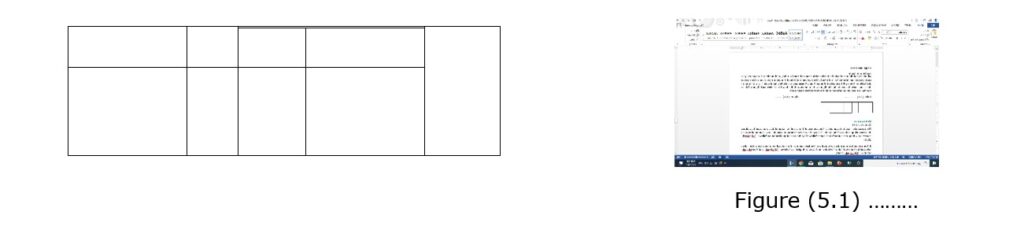
All tables and figures should be labeled with clear and concise titles, and numbered sequentially in each chapter as referred to in the text. The number and title of the table should be written above the table on the right hand side if it is an Arabic thesis and on the left hand side if it is an English thesis as shown below. As for the figures, the number and title is written below each figure. Tables and figures should be referred to in the text before being used.
Table (3.1) …………….
References
Citation in text
The researchers have to document all the sources of the scientific material that was used to address the research questions of the study. This can be achieved through using in- text citation after each source by writing the author’s last name followed by the year of publication as follows: (Ghalwash, 2006)
If the source has more than two authors, the last name of the first author should be written then followed by the word “et al” whether in Arabic or English as follows: (Ghalwash and Abu-shanab, 2006) or (Ghalwash, et at 2006)
Reference list and Bibliography
Examples of writing different types of references:
| Journal article | Author, A.A. and Author, B., Year, Title of article. Title of journal, Vol (issue), pages |
| Evans, W.A., 1994. Approaches to intelligent information retrieval. Information processing and management, 7 (2), 147–168. | |
| Book | Author, A., Year. Title of book. Place of Publication: Publisher. |
| Mercer, P.A. and Smith, G., 1993. Private viewdata in the UK. 2nd ed. London: Longman. | |
| Chapter | Author, A., Year. Title of chapter. In: A. Editor and B. Editor, eds. Title of book. Place of publication: Publisher, pages. |
| Bantz, C.R., 1995. Social dimensions of software development. In: J.A. Anderson, ed. Annual review of software management and development. Newbury Park, CA: Sage, 502–510. | |
| Internet document | Author, A., Year. Title of document [online]. Source. Available from: URL [Accessed date Mon Year]. |
| Holland, M., 2004. Guide to citing Internet sources [online]. Poole, Bournemouth University. Available from: http://www.bournemouth.ac.uk/library/using/guide_to_citing_internet_ sourc.html [Accessed 4 November 2004]. | |
| Newspaper article | Author, A. (or Title of Newspaper), Year. Title of article, Title of Newspaper, day Month, page, column. |
| Independent, 1992. Picking up the bills, Independent, 4 June, p. 28a. | |
| Thesis | Author, A., 1995. Title of thesis. Type of thesis (degree). Name of University. |
| Agutter, A.J., 1995. The linguistic significance of current British slang. | |
| Thesis (PhD). Edinburgh University. | |
| A DOI | Guaranteed never to change, so you can use it as a permanent link to any electronic article. An example of a citation using DOI for an article not yet in an issue is: VanDecar J.C., Russo R.M., James D.E., Ambeh W.B., Franke M. (2003). Aseismic continuation of the Lesser Antilles slab beneath northeastern Venezuela. Journal of Geophysical Research, https://doi.org/10.1029/2001JB000884. Please note the format of such citations should be in the same style as all other references in the paper |
Research data
This journal requires and enables you to share data that supports your research publication where appropriate, and enables you to interlink the data with your published articles. Research data refers to the results of observations or experimentation that validate research findings, which may also include software, code, models, algorithms, protocols, methods and other useful materials related to the project.
Below are a number of ways in which you can associate data with your article or make a statement about the availability of your data when submitting your manuscript. When sharing data in one of these ways, you are expected to cite the data in your manuscript and reference list. Please refer to the “References” section for more information about data citation. For more information on depositing, sharing and using research data and other relevant research materials.
Research Elements
This journal enables you to publish research objects related to your original research – such as data, methods, protocols, software and hardware – as an additional paper in a Research Elements journal.
Research Elements is a suite of peer-reviewed, open access journals which make your research objects findable, accessible and reusable. Articles place research objects into context by providing detailed descriptions of objects and their application, and linking to the associated original research articles. Research Elements articles can be prepared by you, or by one of your collaborators.
Data statement
To foster transparency, we require you to state the availability of your data in your submission if your data is unavailable to access or unsuitable to post. This may also be a requirement of your funding body or institution. You will have the opportunity to provide a data statement during the submission process.
Documenting sources
Plagiarism
Plagiarism is theft. Plagiarism is taking the work of someone else and using it as though it is one’s own. Besides being a serious breach of ethics, plagiarism is against international law. It may lead to reject the Manu Script and may raise the matter to the official authaitolgy.
In your Manu Script, you must acknowledge the ideas, opinions, and theories of other writers. By giving full and proper credits in your text reference and bibliography, you are also enhancing your own work by demonstrating the range and depth of your research.
To avoid plagiarism, make sure you follow these guidelines:
- Make sure that all direct quotations from the work of others are in Italic quotation marks and or indented and are acknowledged by a clear reference to the author and the work.
- Make sure that all materials that you have re-written in your own words are credited to the originator, and that it is easy to identify the source of all the facts and opinions that you are using.
AFTER ACCEPTANCE
Proofs
You may list the corrections (including replies to the Query Form) and return them to our e-mail. Please list your corrections quoting line number. If, for any reason, this is not possible, then mark the corrections and any other comments (including replies to the Query Form) on a printout of your proof and scan the pages and return via e- mail. Please use this proof only for checking the typesetting, editing, completeness and correctness of the text, tables and figures. Significant changes to the article as accepted for publication will only be considered at this stage with permission from the Editor. We will do everything possible to get your article published quickly and accurately. It is important to ensure that all corrections are sent back to us in one communication: please check carefully before replying, as inclusion of any subsequent corrections cannot be guaranteed. Proof reading is solely your responsibility.
Fees and Charges
Reviewing Fees 700 L.E, After Acceptance the Journal charge 220 L.E per Paper, the total amount is deducted from 700 L.E Reviewing Fees.